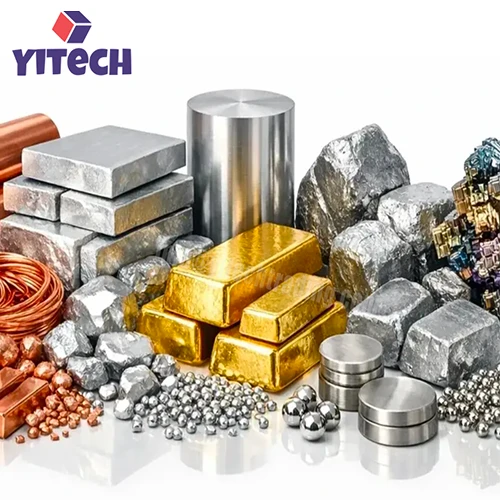
Characteristics of Non-Ferrous Metals
Strength and Hardness-The strength and hardness of non-ferrous metals vary significantly; they are not as consistently strong as ferrous metals. Some pure non-ferrous metals, such as aluminum, are relatively soft, but their strength can be enhanced through alloying and heat treatment. Aluminum alloys like 7068 and 7075, for instance, are used in aircraft due to their excellent strength and corrosion resistance. Conversely, some non-ferrous metals-such as tin, lead, and zinc-possess low strength and hardness. At the other end of the spectrum, titanium offers strength comparable to certain types of steel while boasting a far superior strength-to-weight ratio, making it an essential material in aerospace and medical fields (e.g., for custom human implants).
Magnetism-When it comes to magnetism, non-ferrous metals are consistent: none of them are magnetic. This makes them an ideal choice for applications where magnetic interference poses a risk-for instance, in hospital MRI machines or sensitive electronic systems, where materials like titanium and aluminum are particularly valuable. However, this lack of magnetism becomes a drawback during recycling; unlike ferrous metals, non-ferrous metals cannot be sorted on a large scale using industrial magnets, which increases recycling costs. That said, once sorted, many non-ferrous metals can be recycled very effectively, retaining their material properties even after being melted down.
Corrosion Resistance-One of the primary reasons for choosing non-ferrous metals over ferrous metals is their resistance to corrosion. While iron rusts and degrades when exposed to oxygen and water, many non-ferrous metals exhibit excellent corrosion resistance, often without the need for protective coatings. Non-ferrous metals resist corrosion in various ways. Many can be anodized or finished with surface coatings to enhance their appearance. For instance, copper develops a distinctive green patina (copper carbonate) that prevents further oxidation, while aluminum forms a thin oxide layer that resists erosion-a process that can be controlled through surface treatments like anodizing. Titanium creates a highly stable oxide film that is resistant to acids, seawater, and bodily fluids. This superior corrosion resistance makes non-ferrous metals well-suited for a wide range of applications, including marine environments, roofing, cladding, chemical processing plants, and biomedical devices or implants.
Density and Weight-In general, non-ferrous metals have a much lower density than ferrous metals. For instance, aluminum has a density of 2.7 g/cm³-roughly one-third that of steel. Titanium has a slightly higher density of about 4.5 g/cm³ (still far lower than steel), but its high strength makes it the preferred choice for aerospace applications. Materials like copper are heavier, yet they possess other advantageous properties, making them ideal for use in electrical systems and similar applications.
Electrical Conductivity-High electrical and thermal conductivity are hallmark characteristics of non-ferrous metals. Copper is the most notable in this regard; its excellent electrical conductivity makes it the preferred material for electrical wiring and various other components. Aluminum, while possessing about 60% of the electrical conductivity of copper, is also widely used due to its good conductivity combined with low density (e.g., in lightweight cables and overhead power lines). Silver is the most electrically conductive of all metals, but its high cost limits its use; it is primarily found in specialized applications such as high-frequency connectors and solar cells. In terms of thermal conductivity, copper and aluminum are highly effective, making them ideal for heat exchangers, radiators, and cookware. As with electrical conductivity, silver ranks highest among all metals for thermal conductivity (429 W/(m·K)), though its high price restricts its use to specific, high-end cooling systems.
Plasticity-Most non-ferrous metals exhibit superior plasticity and ductility compared to ferrous metals. They can generally be shaped through various processes-such as rolling or drawing-without fracturing. This is particularly advantageous for copper (often drawn into fine wires) and aluminum (frequently processed into thin foils). This high degree of plasticity allows for a diverse range of manufacturing methods and end-use applications for non-ferrous metals.
Common Types of Non-Ferrous Metals
Typical non-ferrous metals include aluminum, copper, tin, brass, bronze, zinc, lead, nickel, and titanium, as well as precious metals such as gold, silver, and platinum. A wide range of metals fall under the category of "non-ferrous," and their material properties and applications can vary significantly-for instance, the practical uses of aluminum are vastly different from those of gold. Nevertheless, they share certain common characteristics: they are non-magnetic and generally offer better corrosion resistance than ferrous metals.
Applications of Non-Ferrous Metals
Non-ferrous metals are used extensively across a wide range of industries-from titanium components in jet engines to copper electrical wiring and gold electrical contacts. Their specific applications are often determined by factors such as strength, electrical conductivity, or machinability. Below are several examples categorized by industry: Aerospace: Aluminum and titanium are widely used in aerospace due to their high strength-to-weight ratios, as well as their resistance to heat and corrosion. High-strength aluminum alloys (such as 7075 and 7068) are common, while specific titanium grades (such as Ti-6Al-4V) are utilized in jet engines and landing gear. Other non-ferrous metals used in aerospace include Inconel 718 and 625. Electrical and Electronics: Certain non-ferrous metals are highly valued in this sector for their excellent electrical conductivity. Copper is the primary material for electrical wiring and busbars, while aluminum-owing to its lightweight nature-is used for overhead power transmission lines. Brass and bronze are employed for components like connectors, and precious metals such as gold and silver-which offer superior conductivity-are found in electrical contacts and other compact, high-performance components. Construction: While many people associate large-scale structures with ferrous metals like steel, non-ferrous metals also play a significant role. Aluminum is used for window frames and curtain wall systems. For roofing, which requires weather resistance and corrosion protection, aluminum, copper, and zinc are all suitable choices. Copper is used for piping, cladding, and decorative facades, while bronze and brass are often incorporated as decorative details. Marine: Ferrous metals are prone to rust, making them generally unsuitable for underwater environments. In the marine industry, aluminum bronze (C95400) is an ideal material for propellers and pumps. Copper-nickel alloys are used for seawater piping, while titanium and Monel 400 (a nickel-copper alloy) are highly effective at resisting seawater corrosion. Medical: Because they offer better corrosion resistance than ferrous metals, non-ferrous metals are well-suited for various medical applications. Biocompatible titanium alloys (such as Ti-6Al-4V and Ti-6Al-7Nb) are excellent materials for implants and surgical instruments. Copper and silver are also favored for their antimicrobial properties, making them suitable for use as coatings. Consumer Goods: In the consumer goods sector, the application of non-ferrous metals is remarkably broad-ranging from jewelry and currency (precious metals like gold and silver) and musical instruments (brass) to packaging (aluminum).