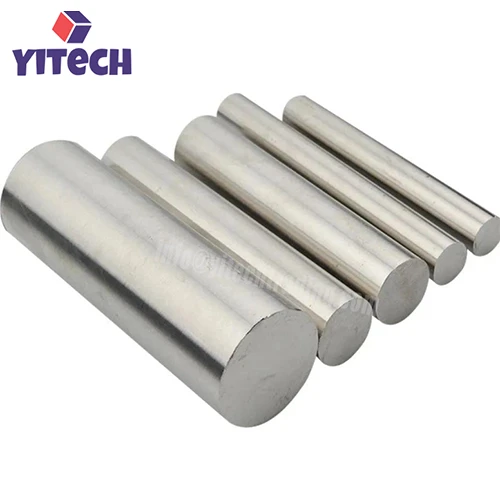
TC4 and TC4 ELI are two versions of the same titanium alloy; they differ primarily in terms of price, interstitial element content, mechanical properties, and application scenarios. The differences between the two are illustrated in the table below.
| Item | TC4 | TC4-ELI |
| Chemical composition | Ti-6Al-4V(Al 5.5–6.75%,V 3.5–4.5%) | For Ti-6Al-4V, the upper limit for Al is typically more stringent (approximately 5.5–6.5%). |
| Interstitial/impurity elements | O ≤ 0.20%,Fe ≤ 0.40%,N ≤ 0.05%,H ≤ 0.015% | O ≤ 0.13%,Fe ≤ 0.25%,N ≤ 0.03%,H ≤ 0.0125% |
| Strength | Higher (tensile strength typically ≥ 895 MPa, yield strength ≥ 828 MPa or thereabouts) | Slightly lower (tensile strength typically ≥ 830 MPa, yield strength around ≥ 760 MPa) |
| Standard | Industrial/aerospace standards such as ASTM B348, AMS, etc. | ASTM F136 (commonly used for medical implants) and certain aerospace standards |
| Application scenarios | Aerospace structural components, engine parts, general industrial applications, sports equipment, etc. | Medical implants, such as artificial joints, bone plates, and dental implants. |
While the table provides a general overview of the differences between TC4 and TC4 ELI in terms of products and applications, the following discussion-based on YITECH's practical production experience and industry standards for titanium and titanium alloys-outlines the distinctions between the two during the manufacturing process.
1. Differences in the selection of raw material-titanium sponge (the most fundamental distinction).
As is well known, titanium sponge is categorized into various grades-such as Super 0A, 0A, Grade 1, Grade 2, Grade 3, Grade 4, and Grade 5-depending on the specific batch and classification standard. Each grade corresponds to a different level of purity (varying impurity content) and, consequently, a different price point.
For TC4: Typically, titanium sponge of Grade 1 or higher is used, with relatively higher allowable upper limits for interstitial elements (O, N, C, H, and Fe).
For TC4 ELI: High-purity titanium sponge (Grade 0A or Super 0A) and more rigorously screened alloying raw materials must be used. This ensures that the levels of interstitial elements and impurities-such as oxygen, nitrogen, and iron-are kept to a minimum from the very source. This results in higher raw material costs, as well as stricter requirements regarding supplier qualifications and batch-to-batch consistency.
2. Differences in Vacuum Arc Remelting (VAR) cycles (resulting in higher purification precision)
TC4: Typically processed via Vacuum Arc Remelting (VAR); two melting cycles are generally sufficient to meet compositional requirements.
TC4ELI: To reduce the content of interstitial elements to extremely low levels, more thorough purification is required. This necessitates three melting cycles. Furthermore, the process demands a higher vacuum level within the furnace and more stringent control.
3. Differences in Post-Processing
The forging processes differ, primarily regarding the required temperatures: TC4 generally requires only a single-heat forging process, whereas TC4ELI necessitates a two-heat forging process. Furthermore, the specific processing requirements vary-involving a sequence of three upsetting and three drawing operations-to ensure that the microstructure of the TC4ELI alloy meets more stringent standards.
4. Quality Control and Cost
TC4: Testing is conducted in accordance with general industrial or aerospace standards.
TC4 ELI: Requirements for the frequency of chemical composition analysis and sampling are more stringent; in particular, interstitial elements must be analyzed with high precision. Medical-grade material (ASTM F136) also requires additional testing for biocompatibility, fatigue, and fracture toughness. There are also higher requirements for process documentation and traceability.
Cost: TC4 ELI is typically 20–35% (or more) expensive than standard TC4.
Production Licensing: There are no special requirements for the production of standard TC4. The production of TC4 ELI, however, requires certification for medical-grade titanium materials. Specific requirements may vary depending on the customer.
In summary, the production processes for TC4 and TC4ELI are not "entirely different routes"; rather, TC4ELI is based on the same fundamental process but incorporates stricter requirements for raw material purity and melting/purification. TC4 prioritizes a balance of cost-effectiveness and strength, whereas TC4ELI utilizes more advanced purification techniques to achieve superior toughness and lower impurity levels-making it well-suited for medical implants and critical cryogenic applications. TC4 can be considered the "standard high-strength" version, while TC4ELI is the "high-purity, high-toughness" version. Choose TC4 when higher strength is required; choose TC4ELI when better toughness, cryogenic performance, or suitability for human implants is needed.